
“Where art thou, O man?”
Spiritual Care to Individuals and Families in Crisis
To anyone called to offer care to others in the name of God, the lives and the suffering of the men, women, and children they meet may press close on every side, and threaten to overwhelm. There is a teenaged daughter in a monstrous cycle of addiction. There is a man in despair who considers ending his life. There is a family torn apart by tragedy or dissention, and a community marred by chaos and violence. There are many ways for a caregiver to approach suffering and seek poise in the midst of so much pain and confusion. Many viewpoints compete for the attention of the spiritual caregiver: psychological, medical, legal, and even political. But will the spiritual caregiver be able to see and adopt an approach that is truly spiritual, which is oriented to the Uncreated and which beckons the help of God at every moment?
This four-week online course on spiritual care to individuals and families in crisis is designed for clergy, Orthodox lay people who have vocations in the helping professions, and for everyone who is called to be a spiritual caregiver to someone else. The course introduces participants to the contours of Hypostatic Spiritual Care, as especially anchored in the theological vision of Saint Sophrony the Athonite. It invites deeper exploration into the aspects of the Orthodox tradition which initiate people to the ways of God and man during times of adversity. The course also describes four unique “phases” in spiritual care, during which everyone in the helping encounter (including the caregiver) can establish positions towards each other and God which create proximity to total transformation and every prize in the spiritual life.
What You’ll Learn
By the end of the course, you will be able to:
Articulate a theological anthropology of spiritual care grounded in the human calling to Personhood, distinguishing the spiritual “load-bearing frame” of life in God from reliance upon primarily psychological and autonomous human resources.
Apply the two-fold perspective to human suffering, maintaining sight of both created and Uncreated realities and discerning the epistemological gap between earthly experience and the perspective disclosed through living contact with God.
Describe the dynamics of the second stage of spiritual life and their significance for spiritual care, including suffering, kenosis, enlargement of the heart, the struggle against self-love, and growth toward hypostatic love and Personhood.
Practice a hypostatic approach to supporting the turn to God, in which caregiver and care-seeker remain persons-in-development who seek God together through prayer, self-emptying love, discernment, and faithful movement along the Way of the Lord.
Course Format & Schedule
Live Zoom Sessions:
Mondays, 8:00–8:45 p.m. ET
Dates:
November 23–December 14, 2026
Access Period:
November 16, 2026–January 16, 2027
-
Introduces the hypostatic understanding of the human person and explores how human life is meant to be lived in continual reference to God. The session contrasts this spiritual load-bearing frame with the psychological and autonomous supports upon which human beings come to rely after the Fall, particularly when carrying suffering and adversity.
-
Explores St. Sophrony’s vision of human beings as capable of simultaneously perceiving earthly and heavenly realities. Particular attention is given to the created and Uncreated, the epistemological gap between them, and the spiritual caregiver’s task of maintaining this two-fold vision in the midst of human suffering.
-
Examines St. Sophrony’s teaching on the second stage of spiritual life, when the experience of grace may give way to struggle, perceived abandonment, suffering, and spiritual dryness. The session considers the hidden formative possibilities of this stage and the ways suffering can become an arena for kenosis, enlargement of the heart, and growth toward Personhood.
-
Considers the spiritual caregiver’s role in accompanying a suffering person as he or she turns toward God and begins again to walk the Way of the Lord. The session explores prayer, discernment, the Commandments, servanthood, self-emptying love, and the caregiver’s own spiritual position as essential dimensions of hypostatic spiritual care.
Meet Your Instructor
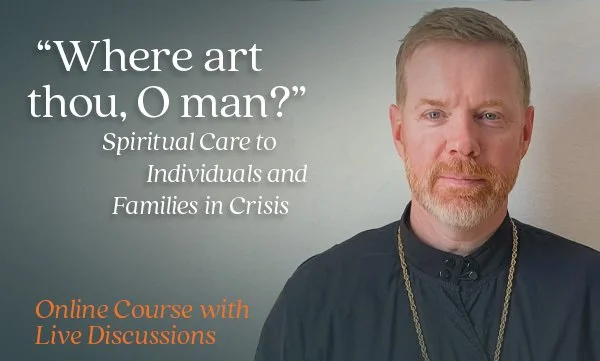
The Very Rev. David Alexander, Ph.D.
Assistant Professor of Pastoral Care & Counseling
Fr. David Alexander is an Archpriest of the Antiochian Orthodox Christian Archdiocese of North America and Assistant Professor of Pastoral Care & Counseling at St. Vladimir’s Orthodox Theological Seminary. He is a longtime student and associate of Professor Renos Papadopoulos, founder of the Centre for Trauma, Asylum and Refugees (CTAR) at the University of Essex in the United Kingdom. After completing his Ph.D. under the supervision of Professor Papadopoulos and Archimandrite Nikolai Sakharov, Fr. David served for nine years as a fellow at CTAR, traveling throughout the world with Professor Papadopoulos and collaborating in refugee care, research, writing and teaching, organizational consultation, and clinical and academic supervision.
His 2025 book, Leaping into the Hands of God: Lessons from My Teachers on Hypostatic Spiritual Care (SVS Press), presents the foundational principles he received from his teachers during those years. Fr. David has worked full-time with survivors of natural disaster and political violence for more than twenty years. He has participated in crisis response, relief, and development efforts on six continents. He holds multiple professional licensures, certifications, and subspecialties related to trauma and crisis care and is the author of more than twenty book chapters and peer-reviewed articles in the fields of refugee care, trauma care, spiritual care in crisis, and caregiver supervision. His work is particularly shaped by hypostatic theology and its implications for understanding the fundamental questions of care between persons.
Tuition & Registration
Course Fee: $200
Refund Policy: No refunds after November 16, 2026
To participate, you’ll need to create a username and password during registration. All course materials and recordings will remain available through January 16, 2027.
Requirements: This course is designed for clergy who give pastoral counsel, Orthodox lay people who have vocations in the helping professions, and anyone who is called to be a spiritual caregiver in some way, for someone.
What’s Included
4 live discussion sessions (~45 min. each)
4 pre-recorded lectures
4 slide presentations to accompany each lecture
Optional reading materials
Access to session recordings and all course materials from November 16, 2026–January 16, 2027
You may submit questions ahead of time for each live Zoom discussion with your professor.
Frequently Asked Questions
-
No. This is a non-credit, non-transferable enrichment course designed for personal spiritual and theological growth.
-
No. While the course is grounded in the Orthodox tradition, it welcomes students of all Christian backgrounds and those exploring Orthodoxy.
-
No problem. All live Zoom discussions will be recorded and available to watch anytime during the access period.
-
After registering, you'll use the login credentials you created to access the course platform. All content will be available starting November 16, 2026.
-
No, readings are optional and provided for those who want to explore topics more deeply.
-
Not at this time. This course is for personal enrichment and does not offer a certificate of completion.