
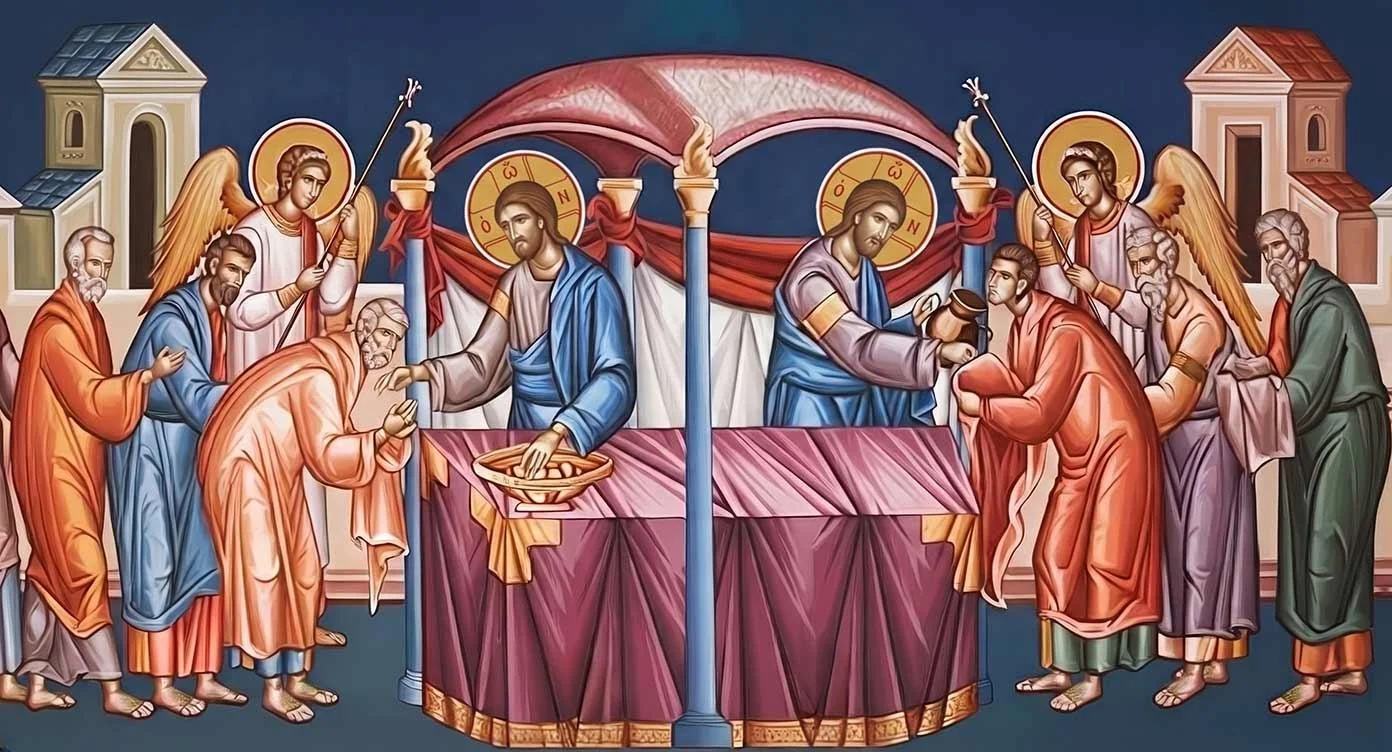
Living in Communion: Orthodox Ethics in Light of the Eucharist
Discover How the Eucharist Shapes the Whole of Christian Life
It is easy to imagine that Communion concerns only a couple of hours on Sunday morning — that once we leave church, the rest of life carries on untouched. The Orthodox tradition insists otherwise. To receive the Eucharist is to be united to Christ, and that union lays claim to everything: our marriages, our money, our care for the poor, and the way we meet a world fractured by violence.
What does it mean to live eucharistically? In this four-week online course, Fr. Philip LeMasters explores how celebrating and receiving Communion calls us to grow into the likeness of God in holiness amid the challenges of living faithfully each day. Drawing on biblical, patristic, liturgical, and contemporary sources, and open to all Christians, the course invites you to offer every dimension of daily life for healing and transformation in the Kingdom of God.
What You’ll Learn
By the end of the course, you will be able to:
Discover why the moral life is grounded in the Eucharist — and what it means to live in communion with Christ well beyond Sunday morning
Explore the deep connection between the offering of bread and wine and a couple's offering of themselves in marriage
Reflect on how the divine mercy we receive in Communion calls us to share it with our needy and suffering neighbors
Learn to approach the hard work of reconciling with enemies in light of the Divine Liturgy's petitions for peace
Course Format & Schedule
Live Zoom Sessions:
Tuesdays, 8:00–8:45 p.m. ET
Dates:
October 6 – October 27, 2026
Access Period:
September 29 – November 29, 2026
-
What if the moral life begins not with a rulebook but with the chalice? Drawing on Fr. Alexander Schmemann and St. Maria Skobtsova, we open by exploring how receiving the Eucharist calls us to offer every dimension of our lives for growth in communion with God and with our neighbor.
-
The Lord's first sign was worked at a wedding. Informed by St. John Chrysostom and contemporary Orthodox figures, this session presents marriage as an offering of the man-woman relationship — the giving of two selves in parallel with the offering of bread and wine at the altar.
-
Christ identified Himself with the hungry, the stranger, and the needy. Shaped by the anaphora and philanthropic ministry of St. Basil the Great, this session explores how those freely nourished by the Lord's Body and Blood may respond with integrity to the suffering neighbors in whom Christ is present.
-
How do we pursue peace in a world fractured by violence? Reflecting on the vision of peace embodied in the Divine Liturgy — and the challenges that bloodshed poses to holiness — we close by considering peacemaking as a way of uniting ourselves more fully to Christ, who offered His Body and Blood for the life of the world.
Meet Your Instructor
V. Rev. Dr. Philip LeMasters
Professor of Christian Ethics
V. Rev. Dr. Philip LeMasters is Professor of Religion and Director of the Honors Program at McMurry University. He received his Ph.D. in Christian Theology and Ethics from Duke University in 1990 and is the author of Sex and Salvation (St. Vladimir's Seminary Press, 2025), along with several other books and essays in Christian ethics. He teaches adjunctively for the Antiochian House of Studies and for St. Vladimir's Seminary, where he is also a longtime member of the Board of Trustees.
An archpriest of the Antiochian Orthodox Christian Archdiocese of North America, Fr. Philip serves as priest of St. Luke Orthodox Church in Abilene, Texas. He brings together decades of pastoral ministry and academic scholarship, offering students both the lived experience of the parish and the depth of a career devoted to Christian ethics.
Tuition & Registration
Course Fee: $200
Refund Policy: No refunds after October 5, 2026
To participate, you’ll need to create a username and password during registration. All course materials and recordings will remain available through the end of the access period.
What’s Included
4 live discussion sessions (~45 min. each)
4 pre-recorded lectures
4 slide presentations to accompany each lecture
Optional reading materials
Access to session recordings and all course materials throughout the access period
You may submit questions ahead of time for each live Zoom discussion with your professor.
Frequently Asked Questions
-
No. This is a non-credit, non-transferable enrichment course designed for personal spiritual and theological growth.
-
No. While the course is grounded in the Orthodox tradition, it welcomes students of all Christian backgrounds and those exploring Orthodoxy.
-
No problem. All live Zoom discussions will be recorded and available to watch anytime during the access period.
-
After registering, you'll use the login credentials you created to access the course platform. All content will be available from September 29 – November 29, 2026.
-
No, readings are optional and provided for those who want to explore topics more deeply.
-
Not at this time. This course is for personal enrichment and does not offer a certificate of completion.