
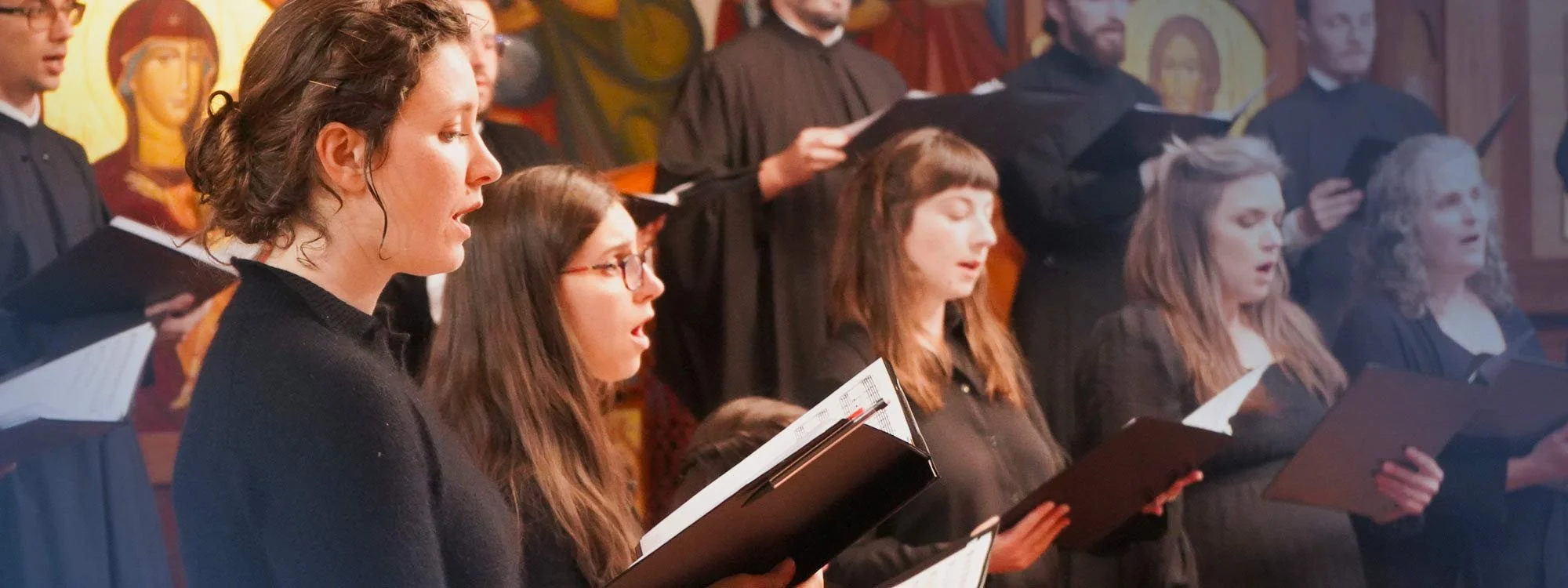
Hearing the Church’s Hymns: Music and Meaning in Lent and Holy Week
Discover how sacred poetry and song carry the depths of Scripture
The Lenten Triodion holds some of the Orthodox Church’s most searching and beautiful poetry—the hymns that carry the faithful from before the fast, through Lent, and into Holy Week. They range from the penitential depths of the Great Canon to the festal wonder of the Akathist Hymn, and they do more than fill the services: they teach, interpret Scripture, and were made to be sung.
In this four-week online course, Dn. Harrison Russin opens the hymnography and music of the Triodion as a single art. Through four case studies—the Great Canon, the daily idiomela, the Akathist, and the hymns of Holy Week—you’ll learn how these hymns embed scriptural interpretation and how their music carries theological meaning. Whether you sing in a choir or simply pray these services, you’ll come away listening with new attention.
What You’ll Learn
By the end of the course, you will be able to:
Discover how the hymns embed Scripture and open up its meaning, retelling the story of salvation in song
Hear how the music itself conveys theological meaning, not merely mood
Engage the Triodion’s landmark hymns up close—from the Great Canon to the Akathist
Come away singing and hearing Orthodox hymnography with a new awareness

Parish Package
Hear the Music and Discover the Meanings With Your Community
This 4-week online course isn’t just for individuals—it’s also ideal for parishes looking to deepen their spiritual life together. With the Parish Package, your community gains full access to the course and the ability to learn, reflect, and grow as one body.
Use this course as part of your adult education offerings, catechumenate formation, Lenten series, or ministry team training. Gather together to view each week’s lecture, participate in the live Zoom sessions, and reflect through guided discussion.
What’s Included for Parishes:
$500 group discount
Unlimited parish access for clergy, lay leaders, and members
Permission to stream lectures and Zoom sessions as a group
Reflection questions and materials for guided discussion
All course content available through October 30, 2026
Course Format & Schedule
Live Zoom Sessions:
Tuesdays, 8:00–8:45 p.m. ET
Dates:
August 4 – August 25, 2026
Access Period:
July 28 – October 30, 2026
-
How does a single hymn become a school of repentance? We explore St. Andrew of Crete's Great Canon—the way it weaves scriptural interpretation into its verses, and the bond it forges between text, meter, and music.
-
The idiomela—shorter hymns sung twice a day through Lent—quietly echo ancient Scripture readings from the Jerusalem lectionary. We uncover those connections and ask what these hymns reveal about the meaning of the fast itself.
-
Fifteen centuries old and of unknown authorship, the Akathist Hymn holds great paradoxes together through poetic repetition and music. We examine its acrostic structure and the artistry that lets it sing the unsayable.
-
The hymnography of Holy Week speaks in challenging, confrontational language. Through its "prophetic matrix" we learn to recognize and confess our own betrayal of Christ, closing with the Canon of Holy Thursday and its echoes of Proverbs 9.
Meet Your Instructor
Rev. Dn. Harrison Basil Russin, Ph.D.
Assistant Professor of Liturgical Music, St. Vladimir’s Seminary
Director of Music, Three Hierarchs Chapel
Dn. Harrison Russin has taught and directed liturgical music at St. Vladimir’s Orthodox Theological Seminary since 2016. He earned his M.Div. from St. Vladimir’s in 2013 before pursuing graduate study in historical musicology at Duke University, where he completed his Ph.D. in 2021.
His doctoral research examined musical settings of the Creed in the Mass in fourteenth- and fifteenth-century France and Italy, and he has published and lectured widely on Orthodox liturgical music. As director of music for Three Hierarchs Chapel, he brings both scholarship and the daily practice of the choir into his teaching.
Tuition & Registration
Course Fee: $200
Refund Policy: No refunds after July 27, 2026
To participate, you’ll need to create a username and password during registration. All course materials and recordings will remain available through the end of the access period.
What’s Included
4 live discussion sessions (~45 min. each)
4 pre-recorded lectures
4 slide presentations to accompany each lecture
Optional reading materials
Access to session recordings and all course materials throughout the access period
You may submit questions ahead of time for each live Zoom discussion with your professor.
Frequently Asked Questions
-
No. This is a non-credit, non-transferable enrichment course designed for personal spiritual and theological growth.
-
No. While the course is grounded in the Orthodox tradition, it welcomes students of all Christian backgrounds and those exploring Orthodoxy.
-
No problem. All live Zoom discussions will be recorded and available to watch anytime during the access period.
-
After registering, you'll use the login credentials you created to access the course platform. All content will be available starting July 28, 2026.
-
No, readings are optional and provided for those who want to explore topics more deeply.
-
Not at this time. This course is for personal enrichment and does not offer a certificate of completion.