
Spoken Icons: Vivid Homilies as Guides for Perceiving Sacred Arts
Explore how early Christian homilies illuminate our experience of sacred spaces and icons. In this four-week online course, you’ll learn how patristic preaching helped worshippers perceive the deeper meanings in liturgical settings—turning words into windows for spiritual perception. This is a journey through rhetoric, architecture, theology, and iconography designed for Orthodox and non-Orthodox Christians alike.
By the end of the course, you will be able to:
Understand the use of vivid description in patristic homilies
Analyze meaning in sacred architecture: its arrangement, décor, and iconography
Identify and explore interpretation of sacred art and architecture in patristic homilies
Examine ways patristic homilies guide physical and spiritual perception
Sign Up Today!
Course Information
Course Description
4 Recorded video lecture by the professor
4 PowerPoint Slides
Optional Readings
This is a wonderful opportunity to hear from and work with the dynamic faculty of St Vladimir’s Seminary.
Meet Your Instructor
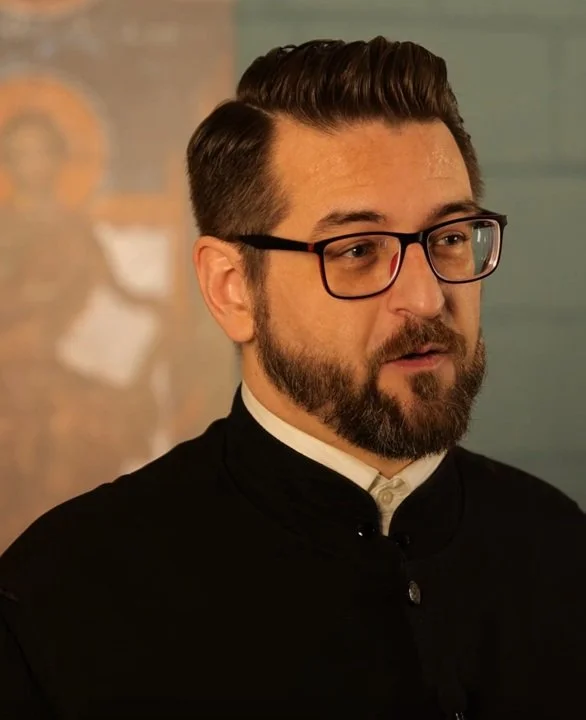
Rev. Fr. Dr. Lucas Lynn Christensen
Ph. D. (Notre Dame ’25)
Assistant Professor of Sacred Arts, Assistant Director, St. Vladimir’s Compelling Preaching Project
The Rev. Dr. Lucas Lynn Christensen is a published scholar on sacrificial theology in the Divine Liturgy of St. Basil and the influence of North African church architecture on St. Maximos’s Mystagogy. He is a research feallow for the interdisciplinary project, “Assessing the Impact of Sacred Art on Individual Experience, Memory, and Spiritual Understanding,” at the University of Notre Dame. Fr. Lucas earned his M.Div. from Holy Cross Greek Orthodox School of Theology in 2016.
Sign Up Today!
Spoken Icons
Vivid Homilies as Guides for Perceiving Sacred Arts
Lecture 1: Perceiving with the Whole Person
This introduction presents the concepts we will use during this course. Foundational to our study are topics in rhetoric, sacred space, physical perception, spiritual perception, theology of icons, and the iconicity of homilies.
Lecture 2: The Meaning of Sacred Space
In our second session, we explore the rich, paradisal imagery presented by our sacred architecture, with a vivid sixth-century description of Hagia Sophia as our case study.
Lecture 3: The Location of Sacred Ritual
In our third session, we examine what it means to be located “here” in our liturgical commemorations of sacred events. We will apply this concept to a festal homily on the Transfiguration, preached at Mt. Sinai in front of a mural of Mt. Tabor.
Lecture 4: The Frame of Sacred Art
In our final session, we consider how we interact with narrative iconography. A three-part homily on the Dormition of the Theotokos gives guidance for engaging with the icon of the feast. We conclude with the implications of our study for spiritually perceiving the persons and events we celebrate in our worship through the sacred arts, with homilies guiding us to that encounter.